- Table of Contents
- US University Intakes 2026–2027
- US University Application Deadlines 2026–2027 Calendar
- Early Action vs Early Decision
- Rolling Admissions Explained
- Common App Deadlines
- Application Timeline for International Students
- Documents Required for US University Applications
- Tips to Never Miss a Deadline
- Common Mistakes International Students Make
- Frequently Asked Questions
- Conclusion
US university application deadlines 2026–2027 complete calendar for international students
A single day late and you may miss out on the university of your dreams for an entire year. If you are an international student, you’re not only competing against the admissions office, you’re also dealing with visa applications, finances, English testing scores and mountains of translated transcripts from thousands of miles away!
This guide will explain US university application deadlines 2026 international students academic year in the United States, what they are, why they are important, and how to schedule your application calendar to maximize your chances of success.
Whether you’re planning to apply for Fall 2026 or Spring 2027, knowing the US university application deadlines for 2026 international students is the #1 action item you can take today.
What You'll Learn
- US University Intakes 2026–2027
- US University Application Deadlines 2026–2027 Calendar
- Early Action vs Early Decision
- Rolling Admissions Explained
- Common App Deadlines
- Application Timeline for International Students
- Documents Required for US University Applications
- Tips to Never Miss a Deadline
- Common Mistakes International Students Make
- Conclusion
- Frequently Asked Questions
US University Intakes 2026–2027
To make a start, it’s important to know when US universities begin their academic year. There are three large entry points and not all of them are available in all universities.
Fall Intake (August–September 2026) is by far the most popular and widely available. Most undergraduate and graduate programs start in the fall, and that is when the most seats are available. Competition is greatest and so are the courses, scholarships, and housing.
Spring Intake (January 2027) is a genuine second entry point not a backup plan at many universities. It is appropriate for students who have completed their home country exams in May or June and are unable to complete applications for Fall. Some graduate programs are fairly lenient with their spring admission.
Summer Intake (May-June 2026) is limited and generally only open for graduate programs, ESL programs and a few community colleges. If available in the school you’re interested in, it’s something to look into, but it is not a top priority.
← Scroll to see more →
| Intake | Start Date | Application Window | Best For |
|---|---|---|---|
| Fall 2026 | Aug–Sep 2026 | Aug–Jan 2025–26 | Undergrad and grad, all programs |
| Spring 2027 | Jan 2027 | Jul–Oct 2026 | Graduate programs, flexible starters |
| Summer 2026 | May–Jun 2026 | Nov 2025–Feb 2026 | ESL, select grad programs |
US University Application Deadlines 2026–2027 Calendar
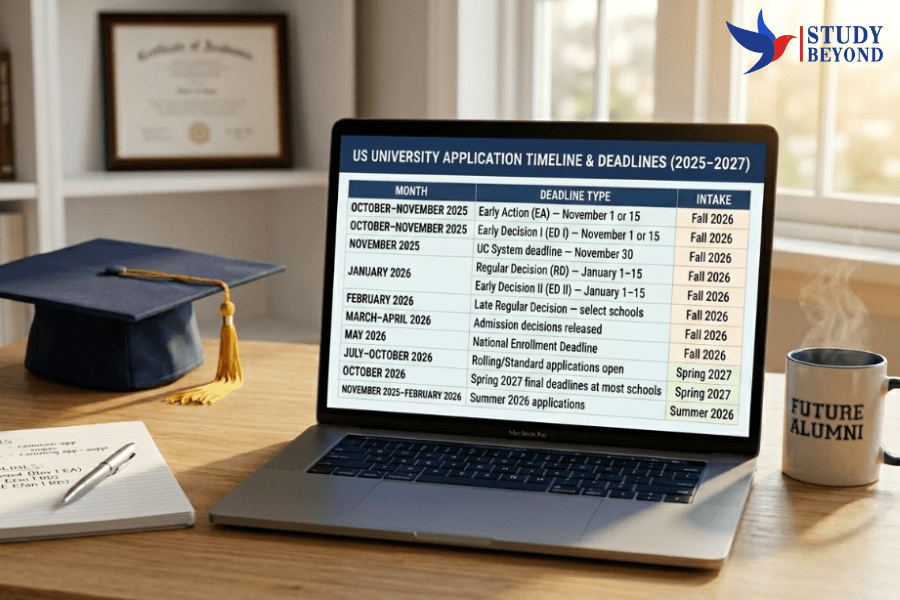
Below is a month by month listing of the University application deadlines for 2026-2027. The dates provided are indicative of industry standards (always check with individual universities).
← Scroll to see more →
| Month | Deadline Type | Intake |
|---|---|---|
| October–November 2025 | Early Action (EA) — November 1 or 15 | Fall 2026 |
| October–November 2025 | Early Decision I (ED I) — November 1 or 15 | Fall 2026 |
| November 2025 | UC System deadline — November 30 | Fall 2026 |
| January 2026 | Regular Decision (RD) — January 1–15 | Fall 2026 |
| January 2026 | Early Decision II (ED II) — January 1–15 | Fall 2026 |
| February 2026 | Late Regular Decision — select schools | Fall 2026 |
| March–April 2026 | Admission decisions released | Fall 2026 |
| May 2026 | National Enrollment Deadline | Fall 2026 |
| July–October 2026 | Rolling/Standard applications open | Spring 2027 |
| October 2026 | Spring 2027 final deadlines at most schools | Spring 2027 |
| November 2025–February 2026 | Summer 2026 applications | Summer 2026 |
Early Action vs Early Decision
The confusion that most International students face is between Early Action and Early Decision. Their deadline is always the first November (or first 15 of the month), but the pledge they make is entirely different.
Early Action (EA) is a program where you can apply early and receive an early decision in December, but there is no binding contract to attend should you receive an acceptance. Other colleges will accept applications for Regular Decision and will be considered until May 1 and offers compared. This is non-binding, and is generally a better option for international students who want time to compare financial aid packages.
Early Decision (ED) is a binding option. Should you be accepted, you will be required to cancel other applications and make a firm commitment to that school. There are also some universities that provide ED II with a January deadline for students interested in committing early after November.
← Scroll to see more →
| Feature | Early Action | Early Decision |
|---|---|---|
| Deadline | Nov 1–15 | Nov 1–15 (ED I) or Jan 1–15 (ED II) |
| Binding? | No | Yes |
| Decision by | Mid-December | Mid-December |
| Can compare aid? | Yes | No — must commit |
| Best for | Students with multiple strong options | Students with a clear first-choice school |
Who should choose Early Decision?
If you are 100% sure of your first-choice school, you have solid grades and test scores, and your financial situation is secure, ED might be a good choice. There is a tendency to accept more in the ED rounds. However, international students seeking maximum financial aid need to be careful after you’ve committed to ED, the negotiating for aid is very difficult.
Who should choose Early Action?
The majority of international students will find EA more suitable. You receive an early answer and still have the time to consider your entire options.
In comparison, other schools such as Carnegie Mellon accept Early Decision (November 1) and schools such as University of Notre Dame and Michigan State University accept Early Action (November 1).
Rolling Admissions Explained
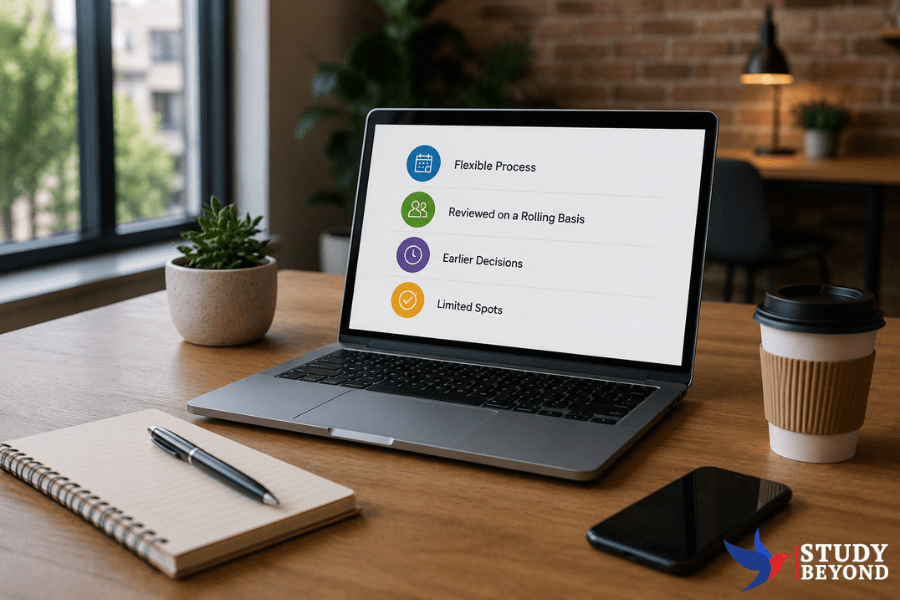
Many universities, especially state universities, and many graduate programs have a rolling admissions system. They do not have a deadline for applications and instead consider applications as they come through and make decisions continuously.
How it works:
You will apply at any time during the application period (usually from August to March). It is reviewed by the admissions team within a couple of weeks. And for those who have a full file and it’s accepted, the decision comes relatively quickly, in as short a period as two to four weeks.
The key advantage:
You control your timeline. The earlier the better, as far as timing goes, and the earlier you apply the more likely you are to get in, especially if you make your application in August or September when the fall awards are made.
The main risk:
Pro Tip:
Don’t just apply for popular scholarships. Apply for “less crowded” university-specific funding. Your chances increase significantly.
Common App Deadlines
Applications to most US universities are made via one or more centralized platforms, making it easier to apply simultaneously to many schools.
The Common App (commonapp.org) is the most widely used platform, accepted by more than 1,000 colleges and universities. The Common App is a single application that will have just one supplement area and deadline, so you can submit to multiple schools in one application. Generally, the Common App will begin on August 1st every year. For the 2026–2027 cycle, the Common App opened on August 1, 2025.
The Coalition Application which was adopted by approximately 150 selective colleges, including many Ivy League and large state universities, is an alternative that is accepted. It is like the Common App, except that there is a Common App profile and each institution provides their own supplement.
There are also school-specific portals in place at universities such as the University of California system, where they use their own UC Application (universityofcalifornia.edu/apply) for all their campuses, including UC Berkeley and UCLA. In addition, graduate programs may have their own portals, which are distinct from Common App. Both UCLA and UC Davis are using the UC Application and the deadline is November 30.
Before completing an application, check out a school’s website to ensure you are completing the application on their platform. It can take weeks to submit through the wrong channel.
Application Timeline for International Students
This is what a well-planned 18-month timeline looks like for a student targeting Fall 2026 entry.
18 months before (January–February 2025):
Research Universities and shortlist 8-12 schools in reach, target, and safety groups. Investigate acceptable testing options. If you haven’t started preparing for IELTS or TOEFL then do so now.
12 months before (August–September 2025):
Take IELTS or TOEFL if you haven’t done so. Try to get the scores before the application period begins. The Common App has opened on August 1 start completing your profile. Ask teachers or professors for a letter of recommendation, providing them with 6-8 weeks’ notice.
9 months before (November 2025):
November 1 or 15 deadline for Early Action and Early Decision applications. Write Statement of Purpose and personal essays. Collect official transcripts and certified translations, as necessary.
6 months before (January–February 2026):
Regular Decision applications are due. Start to do your research for scholarships for international students and keep track of different scholarship deadlines as well; they might be earlier than the admissions deadlines.
3 months before (March–April 2026):
Price compare financial aid offers. The deadline to accept is May 1.
Visa preparation (April–June 2026):
When you accept, your university will send you Form I-20 to help you prepare your visa. Pay your SEVIS fee and arrange your F-1 visa interview with the US Embassy/Consulate in your home country using it. Visa processing may take several weeks (or longer in some countries) so please don’t wait.
If you are applying for admission in Spring 2027, reduce this timeline: July 2026 for application, September / October 2026 (deadline) and November 2026 (start visa preparation).
Documents Required for US University Applications
Most international students will require the following prior to opening of the application period:
Documentation: Passport is required. Be sure not to have a time limit set before you begin your studies.
Authorized Transcripts: Official transcripts from all secondary and post-secondary schools attended. If your thesis or dissertation is in a language other than English, many universities will ask for a certified translation.
English proficiency scores: Most universities will require TOEFL or IELTS scores. These requirements are usually between TOEFL iBT 80–100 or IELTS 6.5–7.0, but competitive programs may require higher scores.
Personal Statement (PS) or Personal Essay: This is where you describe your educational background and your career aspirations, and why you selected this program. A well-crafted SOP may make the difference in a mediocre application. Using a structured approach is recommended with SOP writing, see Study Beyond’s SOP writing guidance.
Letters of Recommendation: Usually two to three, from academic supervisors or employers who can speak to your intellectual ability and character.
Cover Letter: Necessary for most graduate applications and some competitive undergraduate applications.
Letters of recommendation: 2 to 3 letters of recommendation. Academic writing samples: Two to three letters of academic writing. This requirement will also apply to an F-1 visa application.
SAT/ACT: Many colleges are still test-optional after pandemic policies, but good SAT/ACT scores can bolster applications. Review the current policy for each school.
Please book your test 3 months prior to your application deadline in order to be aware of the possibility of retaking the test if required. Study Beyond provides the details of IELTS requirements and preparation.
Tips to Never Miss a Deadline
There is really not much difference between students who submit well-put-together, on-time applications and those who rush at the last minute. These are the steps you can take practically that have the greatest impact.There is really not much difference between students who submit well-put-together, on-time applications and those who rush at the last minute. These are the steps you can take practically that have the greatest impact.
Create a master spreadsheet. Include all universities you are applying to, platform (Common App, Coalition, direct portal), the type of the deadline, the date, required documents, and the scholarship deadline. Review it weekly.
Use calendar alerts 30 days, 14 days, and 7 days before each big date. Add a reminder to follow up with request to confirm that references have been submitted.
Managing scholarship deadlines is a different matter. Many universities have scholarship application deadlines that are weeks or months before the university’s admission deadline. When the scholarship deadline is missed, the admission deadline is met and the student is accepted, but not funded.
Schedule an English test in advance at least 12 weeks. IELTS and TOEFL test centers are overbooked and there is a delay in reportage of the scores. The late bookers do not have a chance to take the retake. Ensure that the scores that are submitted are still within the university’s accepted validity window (typically two years).
Consider time for document processing. Normal times for ordering official transcripts, obtaining them to be notarized, certified translations and shipping to foreign countries is between two and four weeks. Begin this process early in the process.
Start visa preparations for F-1 visa as soon as you get your I-20. The number of available consular appointments differs greatly from country to country. The waiting time at some embassies can be several months. Please do not approach the visa step as a “last step”.
Common Mistakes International Students Make
Some of the common mistakes are the same ones that are made by well-prepared applicants.
Last-Minute
On deadline days, there are always technical problems, which include crashing portals, sluggish uploads, payment failures, etc. A minimum of 48–72 hours in advance.
Mixing up Early Decision and Early Action
If you apply for ED when you intended for EA or you don’t realize that ED is binding, you will be enrolled at a school without having looked at financial aid packages. Make sure you carefully read the admission policy for each university.
Missing scholarship deadlines
There are many students who receive admission offers and forfeit a lot of money in funding due to their late applications for scholarships. Treat the scholarship and admission deadlines as the same, and equally important, date.
Late sitting of Sitting English
October IELTS or TOEFL registration date with November ED date means no buffer. Some universities will only accept scores sent directly from the testing agency, and not self-reported, which will therefore take even longer.
Incomplete application
Your application cannot be reviewed if you don’t have a recommendation letter, an unofficial transcript or a missing financial document. Many sites will have a checklist make sure all the items are checked by the deadline.
Assuming that the deadlines for graduate students are the same as those for undergraduate students. Many graduate programs may have earlier deadlines than undergrad for research assistantships, fellowships, and funded positions, especially. December 1 or 15 is the deadline for some STEM graduate programs to begin in the fall.
Real Student Success Stories
Ahmed from Egypt
Ahmed completed his bachelor’s degree in English-medium education with a 3.8 GPA. Instead of IELTS, he submitted a Medium of Instruction letter and secured the University of Dayton Scholarship covering most tuition costs.
Sofia from Brazil
Sofia used the Duolingo English Test because IELTS centers near her city were limited. She earned admission with scholarship funding at Drexel University for a master’s degree in Data Science.
Kelvin from Kenya
Kelvin applied to 14 universities after struggling with IELTS preparation. He received a scholarship from Rice University after successfully completing an online English interview and submitting strong recommendation letters.
None of these students had perfect profiles.
What made the difference was preparation, persistence, and smart university selection.
Frequently Asked Questions
Q1: When is the deadline to apply to universities in the USA for Fall 2026?
The application deadline for Fall 2026 varies by university and application type. Early Action and Early Decision deadlines are typically on November 1 and November 15, 2025. Regular Decision deadlines usually fall between January 1 and January 15, 2026. Some universities continue accepting applications through February or March 2026, but applying early increases your chances of receiving scholarships and securing admission.
Q2: Is it possible for international students to apply after January?
Yes, some universities continue accepting international applications after January. However, many highly competitive institutions close their Regular Decision admissions by January 15 for Fall 2026. Universities with later deadlines may accept applications through February or March, although scholarship opportunities and available seats may be limited. Spring 2027 applications are generally accepted between July and October 2026.
Q3: Which intake is better for international students: Fall or Spring?
The Fall intake is generally the best option for international students. Most U.S. universities offer a wider range of academic programs, more scholarship opportunities, and a larger intake of international students during the Fall semester. While Spring admission is available at many institutions, the Fall intake provides greater flexibility and a more complete academic experience.
Q4: What is rolling admission?
Rolling admission is an application process where universities review applications as they are received and issue admission decisions continuously, rather than waiting until a fixed deadline. Applications remain open until all available seats are filled, so applying early is strongly recommended to improve your chances of admission.
Q5: Is it possible to apply to U.S. universities without IELTS?
Yes. Many U.S. universities accept alternative English proficiency tests such as TOEFL, Duolingo English Test, or PTE Academic instead of IELTS. Some institutions may also waive the English language requirement if you completed your previous education in English. However, admission requirements vary by university, so applicants should always review the specific policy of their chosen institution.
Q6: When is the best time to begin applying to U.S. universities?
It is recommended to begin preparing at least 12–18 months before your intended intake. For Fall 2026 admission, students should ideally start planning in early 2025. This provides enough time to prepare for English language tests, research universities, gather required documents, write application essays, obtain recommendation letters, and submit applications before the official deadlines.
Conclusion
So, in this detail guide you will know everything about US university application deadlines 2026 international students. It is not a matter of October to figure out which US university application deadlines will apply for 2026-2027.
Those students who got to their school of choice and received significant scholarships to boot are the ones who planned their schedule early in the 2025 school year, took their English tests months before the rush and submitted their applications early.
Major deadlines for planning: Early Action and Early Decision 2025-26 (November 1-15); Regular Decision 2026 (January 1-15); and Spring 2027 (July 2026 onwards).
Each date matters wait a week too long and you may end up paying full tuition at a school that would otherwise cover you, or wait too long and have to pay full tuition at a school that didn’t cover you
It is possible to make a university application to the United States alone, but it will be a difficult plan.
At Study Beyond, our education consultants have aided hundreds of international students in preparing for, and navigating the US admission process, from selecting the right universities to preparing a complete, competitive application on time.
Get in touch with Study Beyond today if you are looking for individual assistance with deadlines, documents and the shortlist of universities.